
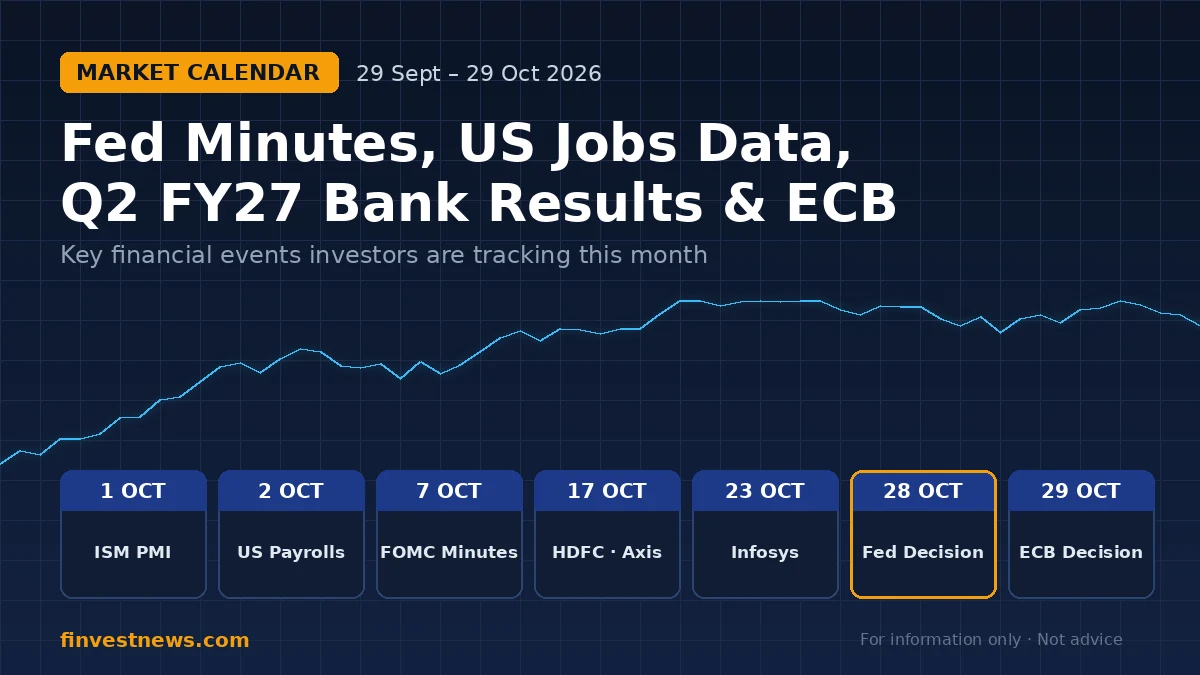
MUMBAI, India – 28 September 2026 – Global markets enter a dense month of scheduled catalysts. The week of 29 September carries more than 250 tracked economic data releases worldwide, the US September jobs report, and a trading holiday on Indian exchanges. October then brings the Federal Reserve’s meeting minutes (7 Oct), the Fed Beige Book (14 Oct), the Q2 FY27 results of HDFC Bank (NSE: HDFCBANK, BSE: 500180) and Axis Bank (NSE: AXISBANK, BSE: 532215) on 17 Oct, Infosys (NSE: INFY, BSE: 500209) on 23 Oct, and back-to-back central bank decisions: the US Federal Open Market Committee (FOMC) on 28 Oct and the European Central Bank (ECB) on 29 Oct. The backdrop is the Fed’s 25-basis-point rate hike on 16 September, which lifted the federal funds target range to 3.75%–4.00%. It was the Fed’s first increase since July 2023.
Event Calendar at a Glance
| Date | Event | Region | Why It Matters |
|---|---|---|---|
| Tue, 29 Sept | ~73 economic data releases globally; 3 IPO pricings, 9 earnings reports, 198 stock splits tracked in the US | Global / US | Broad data flow sets the tone for the quarter-end week |
| Tue, 29 Sept | RBC Capital Global Communications Infrastructure Conference and William Blair Biotech Conference begin (Chicago); FinMark Summit begins (Athens) | US / Europe | Management commentary from telecom-infrastructure and biotech companies |
| Wed, 30 Sept | Heaviest single day of the week — 139 economic events, 1 IPO pricing, 11 earnings, 13 stock splits tracked | Global | Quarter-end and half-year-end; highest event density of the week |
| Thu, 1 Oct | US Challenger Job Layoffs (Sept), weekly jobless claims, S&P Global/ISM Manufacturing PMI (Sept final), US Construction Spending (Aug) | US | Labour and factory data ahead of payrolls |
| Fri, 2 Oct | US jobs report (nonfarm payrolls) expected; ~43 economic events tracked | US | Key labour-market input before the 28 Oct FOMC decision |
| Fri, 2 Oct | NSE and BSE closed for a holiday | India | Indian markets cannot react to US payrolls until the next session |
| Wed, 7 Oct | FOMC minutes from the 15–16 Sept meeting released | US | Detail on the internal debate behind the 16 Sept hike |
| Wed, 14 Oct | Fed Beige Book published | US | Anecdotal regional economic conditions across the 12 Fed districts |
| Sat, 17 Oct | HDFC Bank and Axis Bank Q2 FY27 results | India | First major read on Indian private-bank earnings for July–September |
| Fri, 23 Oct | Infosys Q2 FY27 results | India | Bellwether for Indian IT services demand |
| 27–28 Oct | Next FOMC meeting; rate decision due 28 Oct, 2 PM ET (markets pricing ~70% odds of another hike after the 25bp move on 16 Sept) | US | The month’s biggest scheduled global rate event |
| Thu, 29 Oct | Next ECB Governing Council rate decision | Eurozone | Euro-area policy stance, one day after the Fed |
Note: 2 PM ET on 28 Oct is 11:30 PM IST (US Eastern Daylight Time is UTC−4 until 1 November 2026). The FOMC decision will therefore land after Indian markets close, and the Indian market reaction will come on Thursday, 29 Oct.
Week One: Quarter-End Data Surge (29 Sept – 2 Oct)
Tuesday, 29 September: Data, IPOs and Industry Conferences
About 73 economic data releases are scheduled globally. In the US, 3 IPO pricings, 9 earnings reports and 198 stock splits are being tracked. Investor conferences also begin that day. The RBC Capital Global Communications Infrastructure Conference and the William Blair Biotech Conference open in Chicago, and the FinMark Summit opens in Athens. Industry conferences often produce unscheduled management commentary on demand, pricing and capital spending. That commentary can move individual stocks in the sectors covered even when no formal results are released.
Wednesday, 30 September: The Week’s Heaviest Day
30 September is the heaviest single day of the week, with 139 economic events, 1 IPO pricing, 11 earnings reports and 13 stock splits tracked. It also closes the calendar quarter, and for Indian companies it marks the end of the first half of FY27 (April–September). Quarter-end sessions can see portfolio rebalancing and window-dressing flows. Some intraday moves on the day may therefore reflect positioning rather than fundamentals.
Thursday, 1 October: US Labour and Manufacturing Pulse
Four US releases are due:
- Challenger Job Layoffs (Sept): announced corporate job cuts, an early indicator of labour-market direction.
- Weekly jobless claims: the highest-frequency read on layoffs.
- S&P Global/ISM Manufacturing PMI (Sept final): readings above 50 signal expansion in factory activity, and readings below 50 signal contraction.
- US Construction Spending (Aug): a gauge of the interest-rate-sensitive building sector.
Taken together, these releases show whether the US economy is absorbing tighter policy.
Friday, 2 October: US Payrolls and an Indian Market Holiday
The US jobs report (nonfarm payrolls) is expected on 2 October, alongside about 43 other economic events. The FOMC has now raised rates once and markets are weighing another hike on 28 October, so payrolls are among the most consequential data points of the month.
NSE and BSE are closed for a holiday on 2 October (Gandhi Jayanti). Indian equities will not trade during the US payrolls release. Traders holding positions over the long weekend should note that any global reaction to the jobs data will be priced into Indian markets only when trading resumes on Monday, 5 October.
Mid-October: Fed Insight and Indian Earnings
7 October: FOMC Minutes from the 15–16 Sept Meeting
The minutes cover the meeting at which the FOMC voted 12–0 to raise the federal funds rate by 25 basis points to 3.75%–4.00%. The committee noted that “Inflation remains elevated” (CNBC). Markets will study the minutes for:
- how widely officials support a further hike,
- how much the committee attributes inflation to energy prices, and
- any discussion of the pace and end-point of tightening.
The September Summary of Economic Projections showed that 16 of 18 participants expected another rate increase (CNBC). The minutes may show how firm that expectation is.
14 October: Fed Beige Book
The Beige Book gathers anecdotal reports on economic conditions from the Fed’s 12 regional districts. It is published about two weeks before each FOMC meeting. It does not set policy, but it gives qualitative context on wages, prices and business activity, which feed directly into the committee’s inflation assessment.
17 October: HDFC Bank and Axis Bank Q2 FY27 Results
Two of India’s largest private-sector lenders report July–September quarter results on the same day. Their numbers usually set the tone for the banking earnings season and, given banks’ weight in the index, for the Nifty 50. Investors typically focus on:
- Net interest margin (NIM): the spread between lending yields and funding costs.
- Loan and deposit growth: balance-sheet momentum and funding competition.
- Asset quality: gross and net NPA ratios, slippages and credit costs.
- Management commentary: outlook on credit demand and deposit pricing.
17 October is a Saturday. Results published on a weekend will be reflected in share prices at the opening of the next trading session.
23 October: Infosys Q2 FY27 Results
Infosys is India’s second-largest IT services exporter, and its results are closely watched for revenue growth in constant currency, operating margins, large-deal wins and any revision to full-year FY27 revenue guidance. IT services earnings depend heavily on technology spending by US and European clients. That links this event to the global rate outlook covered elsewhere in this calendar.
Late October: Two Central Banks in Two Days
27–28 October: FOMC Meeting and Rate Decision
The FOMC meets on 27–28 October, and its rate decision is due on 28 October at 2 PM ET. According to the event data underlying this calendar, markets were pricing about 70% odds of another hike after the 25bp move on 16 September. Market-implied probabilities change continuously with incoming data. Payrolls (2 Oct), the FOMC minutes (7 Oct) and the Beige Book (14 Oct) are the main scheduled inputs that could shift those odds before the meeting.
Why it matters for Indian investors: a higher US policy rate generally raises US Treasury yields and can strengthen the US dollar. Historically, that has influenced foreign portfolio investor (FPI) flows into emerging markets, the rupee exchange rate and dollar-denominated commodity prices, including MCX crude oil and bullion. The size and direction of any such effect depend on how far a decision is already priced in, and cannot be predicted with certainty.
29 October: ECB Governing Council Rate Decision
The ECB announces its next monetary policy decision one day after the Fed. A back-to-back Fed–ECB sequence can move the EUR/USD exchange rate, which feeds into global dollar strength and cross-border capital flows. Investors will be watching whether the ECB’s stance diverges from the Fed’s.
Market and Investor Implications
1. Macro data carries more weight this month. With the Fed back in tightening mode after its 16 September hike, each US labour and inflation-related release feeds directly into expectations for the 28 October decision. The 1–2 October cluster (layoffs, claims, PMI, construction spending, payrolls) is the first major test.
2. Indian traders face a holiday timing gap. Because of the 2 October closure, Indian markets will absorb the US jobs report and a weekend of global developments together on 5 October. The same applies after the 17 October bank results, which fall on a Saturday.
3. Earnings season shifts attention to stock-specific fundamentals. HDFC Bank, Axis Bank and Infosys cover financials and IT, two of the largest sector weights in Indian benchmark indices. Their results and guidance will shape views on domestic credit growth and on global technology demand.
4. Rate decisions arrive late in the Indian day. The FOMC announcement falls at 11:30 PM IST on 28 October, and the ECB decision follows on 29 October. Indian markets will price both central bank outcomes within about 24 hours.
None of these events has a predetermined market outcome. Positioning, expectations already priced in, and unscheduled developments can all shape how markets respond. Investors should consult a SEBI-registered investment adviser before making decisions based on scheduled events.
Authoritative Sources
This article is based on a compiled global financial events calendar covering 29 September to 29 October 2026. Details of the Federal Reserve’s 16 September 2026 decision are cross-checked against published reports:
- CNBC, “Fed rate decision September 2026”: https://www.cnbc.com/2026/09/16/fed-rate-decision-september-2026.html
- Advisor Perspectives, “Fed’s Interest Rate Decision: September 16, 2026”: https://www.advisorperspectives.com/dshort/updates/2026/09/16/feds-interest-rate-decision-september-16-2026
- Company results dates are as scheduled. Investors should confirm final dates through the respective companies’ intimations to the stock exchanges under SEBI (Listing Obligations and Disclosure Requirements) Regulations, 2015, Regulation 29 (prior intimation of board meetings).
- Official schedules: Federal Reserve (federalreserve.gov) and European Central Bank (ecb.europa.eu).
Useful Websites for Investors
- BSE Ltd.: https://www.bseindia.com/
- National Stock Exchange of India Ltd.: https://www.nseindia.com/
- Securities and Exchange Board of India: https://www.sebi.gov.in/
Not a SEBI Registered Analyst
I/We am/are not a SEBI Registered Investment Adviser or Research Analyst. All information shared is for educational and informational purposes only and is not intended as a substitute for professional financial advice. All opinions expressed herein are based on my/our personal observations and research. They do not constitute a recommendation or a solicitation to buy, sell, or hold any security. Investments in the securities market are subject to market risks. The value of investments may go up or down. Past performance is not indicative of future results.
You are solely responsible for your own investment decisions. You should conduct your own research and consult with a qualified/certified financial advisor before making any investment based on the information provided here.
I/We may or may not hold positions in the securities mentioned here or anywhere in this website. I/We have no relationship/Sponsorship with/by the companies mentioned unless explicitly stated.